We think we know what wealth looks like.
We look at modern tech billionaires with their private rockets, mega-yachts, and $200 billion net worths, and we assume we are looking at the peak of human accumulation.
But if you adjust for inflation and historical context, those fortunes are pocket change.
In the 14th century, there lived a man whose wealth was so immense that contemporary historians literally ran out of words to describe it. He was the ruler of the Mali Empire, a vast kingdom that stretched across West Africa. His name was Musa Keita, but the world remembers him as Mansa Musa (King of Kings).
Mansa Musa didn’t just have a large bank account. He owned the resource that the entire global economy was built on: Gold. At a time when Europe was struggling through the Dark Ages, plagues, and civil wars, Mali was sitting on half of the world’s active gold and salt reserves.
But the most incredible chapter of Mansa Musa Wealth is not how he collected it, but how a single, generous vacation he took accidentally broke the financial systems of the Mediterranean for a decade. This is the story of the man who was too rich for the world to handle.
The Source of the Empire: The Infinite Money Glitch
To understand how one man could hold so much power, you have to look at the geography of the Mali Empire.
Mali sat directly on top of three massive gold fields (Bambuk, Boure, and Galam) and controlled the trans-Saharan trade routes. Every single gram of gold or salt that moved between West Africa, the Mediterranean, and the Middle East had to pass through Musa’s territory. And on every gram, he took a tax.
The Royal Monopoly:
Under Malian law, all gold nuggets found in the empire belonged to the King. The citizens were only allowed to keep gold dust. This meant that Mansa Musa held an absolute, undisputed monopoly on the global supply of physical gold.
If the Italian city-states wanted to mint coins, or if the Kings of Europe wanted to build gilded altars, they had to buy the gold that originated in Musa’s mines. He was, quite literally, the central bank of the medieval world.
The Great Caravan: When an Entire City Marched Across the Sahara
In 1324, as a devout Muslim, Mansa Musa decided to perform the Hajj—the sacred pilgrimage to Mecca.
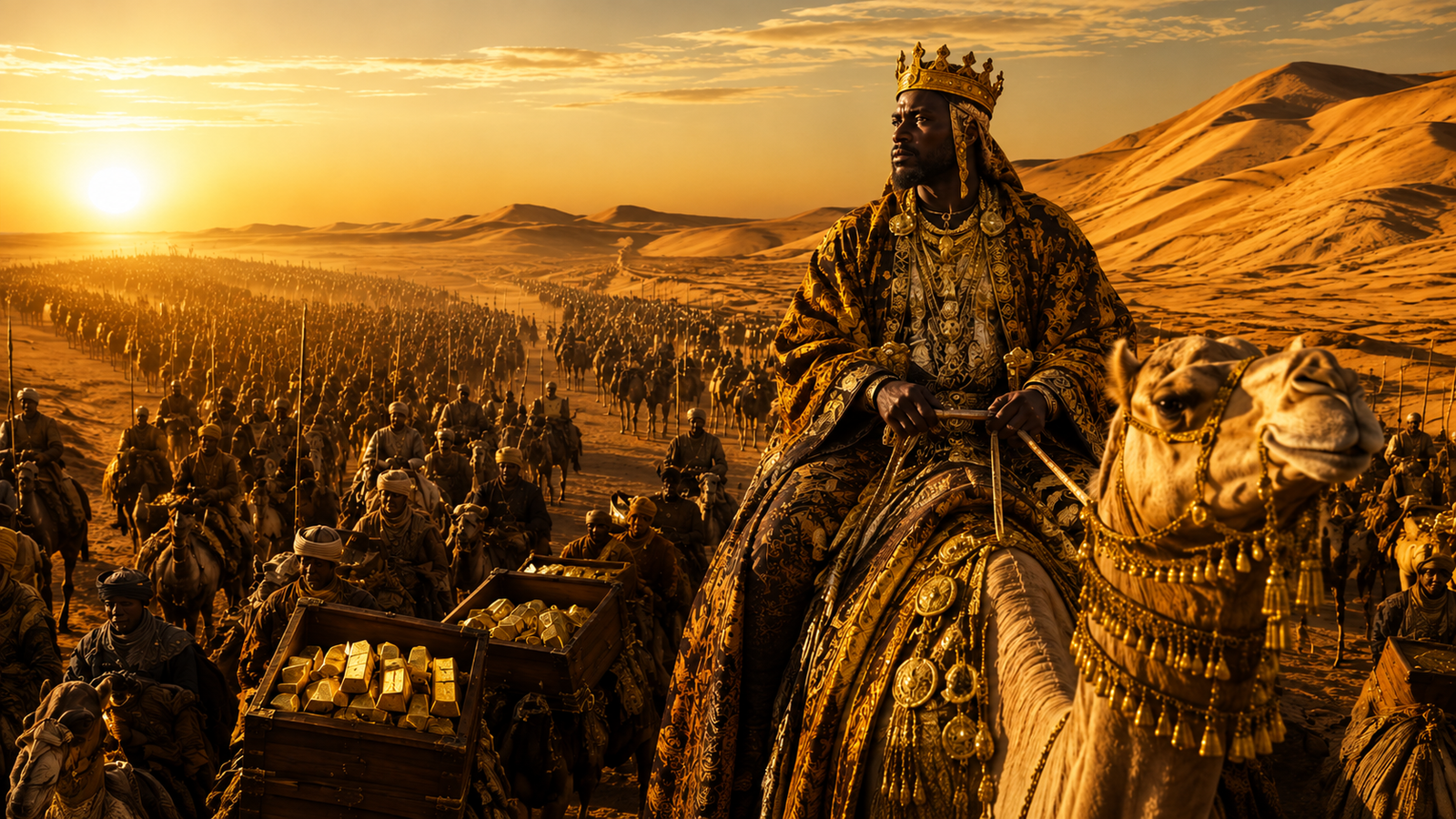
For most people, this was a journey of quiet contemplation. For Musa, it was a 4,000-kilometer state visit. He didn’t just pack a bag; he packed an entire city and marched it across the hostile sands of the Sahara Desert.
The Logistics of the Caravan:
- The Entourage: 60,000 men, including a personal court of 12,000 royal servants.
- The Royal Silk: Every single servant, even the ones carrying the baggage, was dressed in the finest Persian silk.
- The Golden Camels: 80 camels, each carrying between 50 to 135 kilograms of pure gold dust.
- The Guard: 500 heralds carrying golden staffs to clear the path ahead.
As this golden ribbon of humanity wound its way through the desert, it was a moving advertisement of Malian power. For the kingdoms of North Africa and Europe, who had viewed West Africa as a mysterious, dark void, the caravan was a psychological shockwave. It was proof that the richest man on Earth did not live in Rome, Paris, or Constantinople.
The Inflation Shock: Why Giving Away Gold Destroyed Cairo
In July 1324, the caravan arrived in Cairo, Egypt.
The local Sultan, al-Nasir Muhammad, welcomed Musa with royal honors. Musa, overwhelmed by the hospitality and his own religious devotion, decided to show his gratitude. He spent three months in the city, and he began to give away his gold.
He gave bags of gold dust to every poor person he saw. He handed gold bars to local officials. He spent fortunes buying tapestries, silks, spices, and souvenirs in the local bazaars, refusing to bargain and paying double or triple the asking price simply because he could.
The Economic Crash:
It was an act of pure generosity. But Mansa Musa did not understand the laws of Fiat and Scarcity.
By dumping tons of gold into the local economy overnight, he violated the most basic rule of money: When money is abundant, its value drops.
- The market was flooded with gold.
- Because everyone now had gold, the local merchants raised their prices.
- The value of the local currency (the gold dinar) crashed.
Essentially, Mansa Musa’s kindness caused runaway inflation. The price of basic goods (bread, oil, clothes) skyrocketed, making life unlivable for the average citizen of Cairo, Medina, and Mecca. It is estimated that it took more than twelve years for the economies of the Middle East to recover from Musa’s “generous” three-month vacation.
The Only Man to “Short” the Global Gold Market
On his way back from Mecca, Mansa Musa realized the economic disaster he had caused. The markets of Cairo and Alexandria were in ruins.
In a move that proved he was not just a rich king, but an adaptive economic thinker, he decided to fix it.
He executed the first historical “Market Intervention” by a single individual. He went to the wealthy merchants of Cairo and began to borrow back his own gold at extremely high interest rates.
- By borrowing the gold back, he physically removed the excess supply from the market.
- The value of gold began to rise again.
- He stabilized the economy by carrying the debt himself.
It is the only time in human history that a single individual single-handedly controlled the price of gold across three continents.
The Law of Scarcity: Why Money is an Illusion
The story of Mansa Musa Wealth is the ultimate proof of a timeless financial truth: Wealth is not in the material; it is in the scarcity.
If you have a million rupees, you are wealthy. But if everyone in your city is given a million rupees tomorrow morning, no one is wealthy. The price of a cup of tea will simply rise to ₹50,000, and you will be right back where you started.
This is the lesson of the inflation crash of 1324. It is why modern central banks cannot just “print more money” to solve poverty. Money is simply a claim check on human labor and resources. If the resources don’t increase, printing more claim checks just makes the paper worthless.
Frequently Asked Questions (FAQs)
Q: Exactly how rich was Mansa Musa in modern terms?
A: It is impossible to calculate accurately, but economists estimate his net worth would be equivalent to $400 Billion to $600 Billion today—nearly double the net worth of Elon Musk or Jeff Bezos at their peaks.
Q: Did his wealth lead to the downfall of the Mali Empire?
A: Indirectly, yes. His historic caravan put Mali on the European maps (literally—the famous Catalan Atlas of 1375 depicts him holding a massive gold coin). This visual proof of infinite wealth turned Mali into a primary target for Portuguese and European explorers in the centuries that followed, eventually leading to colonization.
Q: What else did he do besides spend gold?
A: He was a massive patron of education. He brought back Islamic scholars, architects, and poets from his pilgrimage and built the legendary University of Sankore in Timbuktu, turning it into the educational capital of Africa.
The King Who Outlived His Gold
Mansa Musa’s gold eventually ran out. His empire was eventually conquered, his mines were exhausted, and the grand mosques of Timbuktu became historical monuments.
But his story survives because it represents the ultimate limit of material wealth. He proved that even if you own half the world’s gold, you cannot break the laws of nature and economics.
Wealth isn’t what you hold in your hands. It is what you build with it. Mansa Musa is remembered today not because he had gold, but because of the universities he founded, the cities he built, and the global economy he accidentally turned on its head.
True value is never in the metal. It’s in the legacy.