Imagine you took a crisp ₹2,000 note, placed it inside a heavy iron vault, locked it with a key, and buried it in your backyard.
Twenty years later, you dig it up. The vault is intact. The note is perfectly clean. It still has the same watermark, the same color, and the same official signature.
But when you take it to the grocery store, you realize something terrifying: It can only buy what a ₹500 note used to buy twenty years ago.
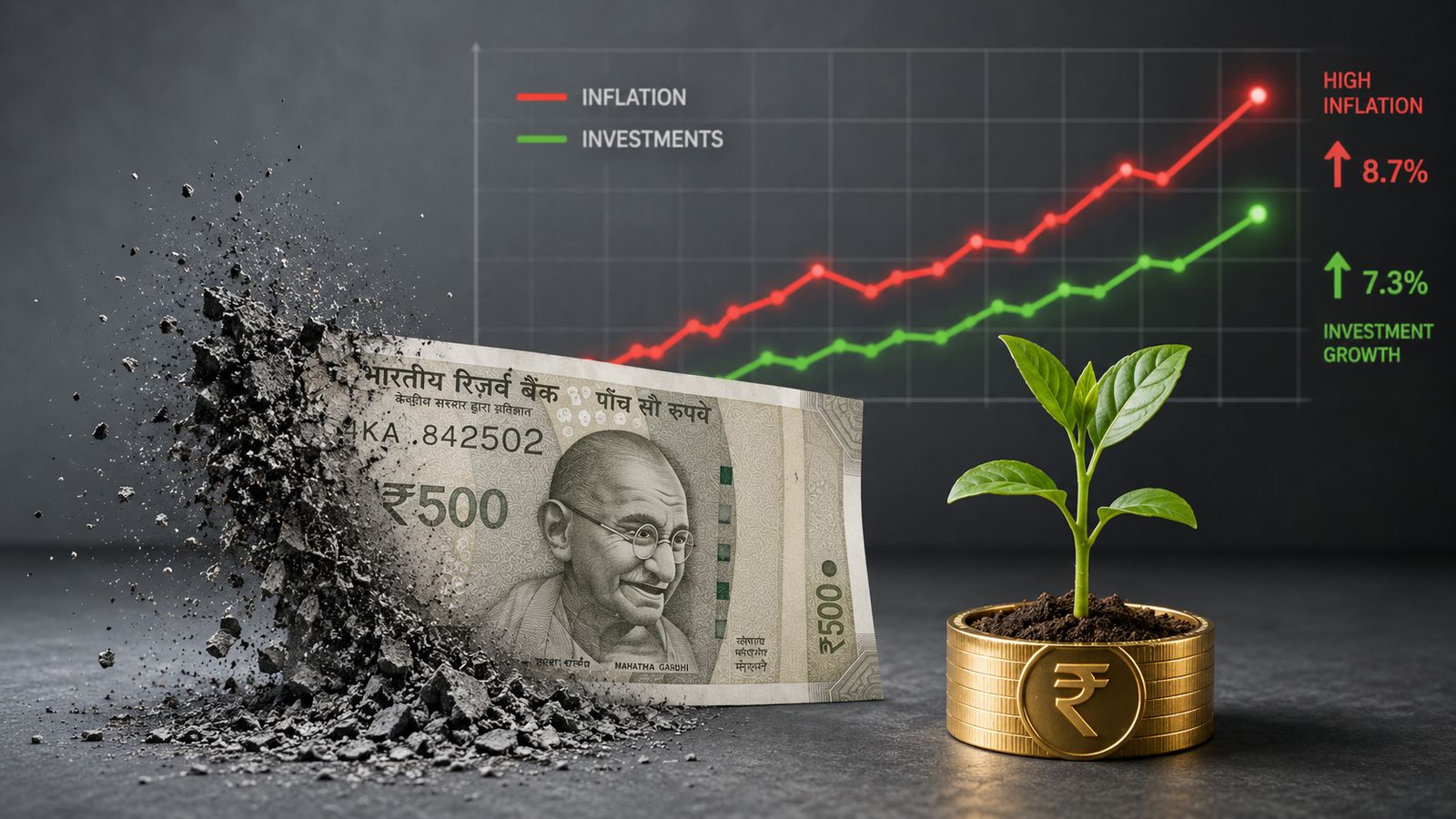
The paper didn’t change. The numbers didn’t change. But the value evaporated.
This is the work of The Silent Eraser—commonly known as inflation. It is the invisible tax that no politician votes on, yet it is levied on every single citizen who saves money. If you are keeping your hard-earned cash in a standard savings account or relying entirely on low-yield fixed deposits, you are not being “safe.” You are actively, guaranteed to lose money every single year.
If you want to protect your wealth, you must learn how to beat inflation with investments. Here is the no-nonsense guide to understanding purchasing power and how to build a financial shield that keeps your money strong.
The Silent Eraser: What is Inflation Actually Doing to Your Cash?
Most people think of inflation as “prices going up.”
- “Milk is more expensive.”
- “School fees went up.”
- “Fuel costs are higher.”
But that is a surface-level view. Inflation is not actually about things getting more expensive; it is about your currency losing its value.
When the supply of money in an economy increases, the purchasing power of every single unit of that money drops. Think of it like watering down a bowl of soup. The soup bowl is still full, but the soup itself is thinner and has less nutrition.
The Rule of 72 (The Halving Trick)
To understand how dangerous this is, you need to use the Rule of 72 to calculate how fast your money will lose half its value.
- The Math: Divide 72 by the current inflation rate (let’s assume a standard Indian inflation rate of 6%).
- The Result: 72 / 6 = 12 Years.
This means that if you keep your money in a non-productive asset (like a locker or a basic savings account), your money will lose half of its purchasing power in just twelve years. Your ₹10 Lakhs will still say ₹10 Lakhs on the screen, but it will only buy ₹5 Lakhs worth of goods.
The Cash Hoarding Trap: Why Your Bank Account is Financial Self-Sabotage
The middle-class dream is built on the safety of the Bank Account. We are taught that keeping money in a bank is “secure.”
But let’s look at the actual math of a standard Fixed Deposit (FD) or Savings Account:
- The Savings Account: Gives you 3% interest.
- The Fixed Deposit: Gives you 6.5% interest.
- The Inflation Rate: Is roughly 6%.
At first glance, the FD looks like it is winning. You make 0.5% profit, right?
Wrong.
Once you factor in Income Tax on your FD interest (which can be up to 30% depending on your tax slab), your “Real Return” (nominal return minus inflation and tax) is actually negative.
- If your FD makes 6.5%, and tax takes away 1.5%, you are left with 5%.
- If inflation is 6%, you are losing 1% of your wealth every year by keeping it in an FD.
You are paying the bank for the privilege of letting your money lose value. It is the ultimate financial trap because it feels safe while silently destroying your future.
The Inflation Shield: 3 Assets That Protect Your Purchasing Power
To beat inflation with investments, you must move your money into assets that have inherent value—things that grow because of inflation, not in spite of it.
Here are the three essential pillars of an inflation-proof portfolio:
1. Equities (The Ultimate Engine)
When inflation rises, companies raise their prices.
- If the price of milk goes up, the dairy company makes more revenue.
- If the price of steel goes up, the steel company makes more revenue.
Because companies can pass their higher costs onto the consumer, their profits (and stock prices) naturally rise with inflation over the long term. - How to use it: You don’t need to pick individual stocks. Just invest in a low-cost Nifty 50 Index Fund or a S&P 500 ETF. Historically, equities have returned 12-15% annually in India over the long term, easily beating inflation.
2. Real Estate and REITs (The Physical Hedge)
As the value of money drops, the value of physical land and buildings rises. More importantly, rent rises with inflation.
- How to use it: If you don’t have the capital to buy a physical apartment (or don’t want the headache of managing tenants), use REITs (Real Estate Investment Trusts). They allow you to buy fractional ownership in commercial properties (like IT parks and malls) for as little as ₹500, and they pay out regular dividends that naturally increase with inflation.
3. Gold (The Classic Crisis Shield)
Gold has been the ultimate global currency for 5,000 years. It has no government, no central bank, and cannot be “printed.”
- How to use it: Do not buy physical jewelry (you lose 10-15% in making charges). Instead, buy Sovereign Gold Bonds (SGBs) or Gold ETFs. They track the price of gold perfectly without the security risks of keeping metal in your cupboard.
The “Real Return” Mindset: Upgrading Your Internal Calculator
The next time you look at any financial product, stop looking at the “Nominal Return” (the number on the brochure). Always ask: “What is the Real Return?”
Real Return=Nominal Return−Inflation−TaxesReal Return=Nominal Return−Inflation−TaxesIf a mutual fund gives you 12%, inflation is 6%, and tax is 10% on gains, your real return is roughly 5%. That is your actual progress. If the real return of an asset is not positive, you are standing still on a moving walkway—you are technically moving, but you aren’t getting anywhere.
Frequently Asked Questions (FAQs)
Q: Is Gold the best way to beat inflation with investments?
A: Gold is a great preserver of wealth, but it is not a great creator of wealth. Over 30 years, gold will maintain your purchasing power, but it won’t grow it significantly. For actual wealth creation, Equities (Mutual Funds) are far superior.
Q: Should I put all my money into Mutual Funds to beat inflation?
A: No. Equities are volatile in the short term. You should never put money you need in the next 3 years into the stock market. Keep your short-term emergency fund in FDs or liquid funds (even if they lose slightly to inflation) because “liquidity and safety” are more important than “beating inflation” when you have an emergency.
Q: How does inflation affect my home loan/debt?
A: This is the one benefit of inflation: It shrinks your debt. If you have a fixed-rate home loan of ₹50 Lakhs, and inflation rises, your salary will eventually rise with inflation, but your loan amount stays the same. The real “value” of what you owe to the bank decreases over time.
Stop Hoarding, Start Planting
Money is not a monument to be preserved; it is a seed to be planted.
If you keep your seeds in a dry box, they won’t spoil, but they will never grow. Eventually, they will just dry up and turn to dust. If you want your financial future to be secure, you have to plant those seeds in fertile soil—in businesses, in land, and in assets that grow with the world.
The “Safety” of the savings account is an illusion. The real safety is in ownership.
Take control of your currency. Move your money out of the vault and into the engine.