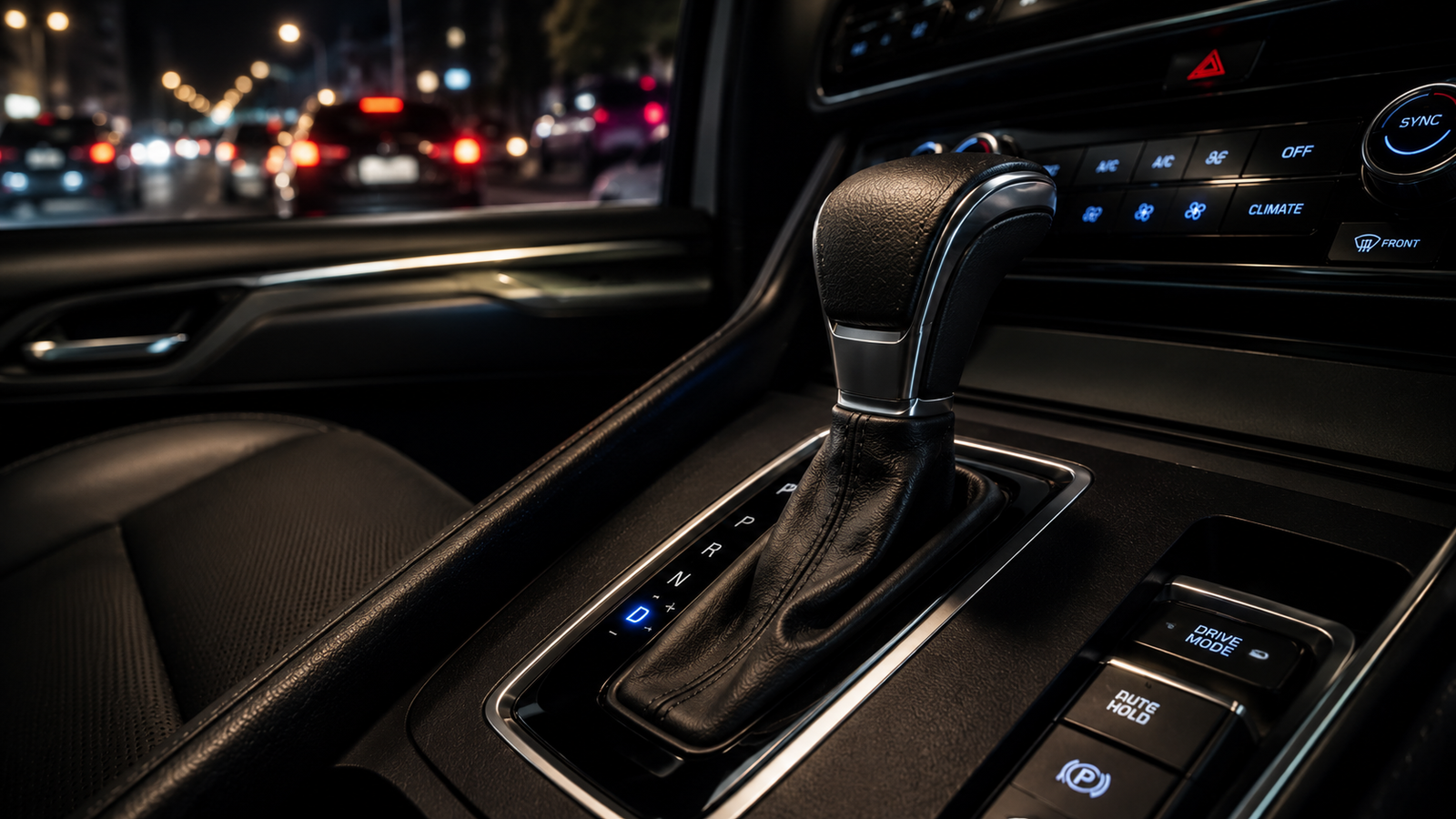
It is 6:00 PM on a Tuesday.
You are stuck at a major city junction. You’ve pressed the heavy clutch of your manual car fifty times in the last ten minutes. Your left leg is cramping, your back is aching, and you are silently swearing to yourself: “My next car is going to be an automatic.”
You are not alone. Across the country, the demand for automatic gearboxes is skyrocketing. We are tired of the daily three-pedal workout.
But when you start researching, the simplicity of “just drive” disappears. You are suddenly hit with a wall of abbreviations: AMT, CVT, DCT, and Torque Converter. The salesman tells you they are all “automatic,” but they behave, cost, and perform in completely different ways.
If you make the wrong choice here, you could end up with a car that jerks every time it shifts, or one that has a gearbox so fragile that a single repair bill will cost as much as a family vacation.
Let’s break down the four major types of automatic cars on the market today so you can choose the exact transmission that fits your lifestyle and your budget.
1. The AMT (The Automated Manual: The Budget Robot)
Let’s start with the cheapest and most common automatic option in India.
What is it?
An AMT (Automated Manual Transmission) is not actually a true automatic. Under the hood, it is a standard manual gearbox with a clutch. However, instead of you pushing the clutch and shifting the gear, a robotic actuator does it for you.
- The Drive Experience: It is highly functional but unrefined. Because it is physically shifting a manual clutch, there is a distinct delay between gears. This is known as the “Head-Nod” effect—every time the car changes gears, your head gently nods forward because of the sudden pause in acceleration.
- The Wallet Impact: This is the cheapest automatic option. It costs only ₹50,000 more than a manual version and gives you almost the same fuel efficiency (mileage).
2. The CVT (Continuously Variable Transmission: The Smooth Cruiser)
If you hate gear shifts entirely, this is your champion.
What is it?
A CVT has no gears. None at all.
Instead of steel gear wheels, it uses a system of two pulleys and a steel belt that constantly change size to keep your engine in its optimal power band. It has infinite gear ratios.
- The Drive Experience: It is the smoothest driving experience money can buy. There are no shifts, so there is zero jerking. It is perfect for relaxed city driving and bumper-to-bumper traffic.
- The “Rubber-Band” Effect: If you step on the gas pedal hard to overtake, the engine will rev loudly and scream, but the car’s speed will take a second or two to catch up. It feels like stretching a rubber band before it snaps forward.
- The Wallet Impact: Highly fuel-efficient in the city, but expensive to repair if the steel belt snaps.
3. The Torque Converter (The Old Faithful: The Reliable Tank)
This is the oldest, most reliable automatic technology in the world. It has been refined over sixty years.
What is it?
Instead of a physical clutch, a Torque Converter uses a hydraulic fluid coupling to connect the engine to the wheels. It literally uses liquid pressure to transfer power.
- The Drive Experience: Incredibly smooth, durable, and reliable. It doesn’t have the “head-nod” of the AMT or the “screaming” of the CVT. It crawls beautifully in traffic and is excellent for driving in hilly terrain.
- The Wallet Impact: Because it uses fluid pressure, there is some energy loss, which means it is the least fuel-efficient of all the automatics. It is also heavier and typically found in larger, more premium SUVs.
4. The DCT / DSG (The Dual-Clutch: The Race Car Tech)
This is the technology developed for Formula 1 cars, now available in family hatchbacks and sedans.
What is it?
A Dual-Clutch Transmission (DCT or DSG) uses two clutches instead of one.
One clutch manages the odd gears (1, 3, 5), while the second clutch “prepares” the even gears (2, 4, 6) in the background. Before the car even shifts, the next gear is already spinning and waiting.
- The Drive Experience: Lightning-fast shifts. It changes gears in milliseconds—faster than a professional racing driver. It is incredibly engaging, punchy, and fun to drive on the highway.
- The Heat Trap: DCTs use complex electronics. In heavy, bumper-to-bumper Indian traffic, the constant shifting can cause the dry-clutch versions to overheat, triggering a warning light on your dash.
The Verdict: Which Gearbox Fits Your Drive?
Now that we have decoded the tech, let’s look at the buying decision.
| Gearbox Type | Best For… | Worst For… | Budget Vibe |
| AMT | Budget buyers, high mileage needs, daily city commute. | Driving enthusiasts, smooth overtaking. | Low Cost (₹) |
| CVT | Relaxed city drivers, family comfort, bumper-to-bumper traffic. | High-speed highway overtaking, sporty driving. | Medium Cost (₹₹) |
| Torque Converter | Long-term reliability, heavy SUVs, hilly terrains. | People obsessed with fuel economy. | Medium-High (₹₹₹) |
| DCT / DSG | Enthusiasts, highway cruisers, high-performance needs. | Heavy traffic crawling (risk of overheating). | High Cost (₹₹₹₹) |
Frequently Asked Questions (FAQs)
Q: Can I park an automatic car on a slope using just the “P” (Park) gear?
A: No! This is a dangerous habit. The “P” gear uses a tiny metal pin called a parking pawl to lock the transmission. If you park on a steep slope without using the handbrake, the entire weight of the car rests on this tiny pin. If it snaps, your car will roll. Always pull the handbrake first, then shift to P.
Q: Why does my automatic car “creep” forward when I lift my foot off the brake?
A: This is a built-in safety and convenience feature called “Creep Function.” It allows the car to roll forward at 5-8 kmph without you touching the accelerator, making it incredibly easy to manage bumper-to-bumper traffic using just your brake pedal.
Q: Which automatic gearbox has the lowest maintenance cost?
A: The Torque Converter and the AMT. Torque converters are nearly indestructible if you change the fluid on time. AMTs are cheap to fix because they use standard manual components under the hood. Avoid used DCTs/DSGs without a warranty, as a gearbox replacement can cost lakhs.
Match the Machine to the Commute
The “Best” automatic is not the most expensive one.
If you spend your life navigating the chaotic, narrow lanes of your local market, buying a high-strung, expensive DCT is a waste of money—you will just overheat the clutch. A simple, smooth CVT or a budget-friendly AMT is your actual best friend.
But if you live for those Sunday morning highway drives where you want to feel the surge of power the moment your foot touches the pedal, save up for the DCT.
Understand your route. Understand your budget. And let the machine do the shifting.