It is the great daily constant.
You wake up, walk to the kitchen, and light the stove. You throw in water, tea leaves, sugar, a chunk of crushed ginger, and a splash of milk. You let it boil until it looks “dark enough,” pour it into your mug, and take a sip.
Sometimes it’s great. Sometimes it’s watery. Sometimes it has a weird, bitter aftertaste that leaves your throat feeling dry. And occasionally, you look at the pot and realize the milk has slightly curdled, leaving tiny white flakes floating on the surface.
Most people blame the milk, the gas stove, or the brand of the tea leaves. But the reality is that making a perfect cup of tea is not a matter of brand; it is a matter of chemistry.
An authentic Masala Chai Recipe is a delicate balance of water, milk solids, aromatic oils, and tannins. If you dump everything into a pot and boil them together, you are essentially forcing these sensitive ingredients to fight each other. To get that rich, velvety, aromatic cup that you get at legendary street stalls—without the bitter aftertaste—you need to understand how temperature, timing, and fats interact in the pot.
The Ginger-Milk Conflict: Why Timing is Everything
Let’s start with the most common kitchen disaster: Curdled Ginger Tea.
You’ve probably noticed that sometimes, when you add freshly grated ginger (adrak) to your boiling tea, the milk splits. You blame the milk’s freshness, but the culprit is actually a plant enzyme inside the ginger called Zingibain.
Zingibain is a proteolytic enzyme, which means its job is to break down proteins. Milk contains a delicate protein called Casein. When you grate raw, cold ginger directly into boiling milk, the active Zingibain immediately attacks the Casein proteins, causing them to clump together and split.
The Temperature Shield:
To stop your ginger from curdling your milk, you must use temperature as a shield.
- The Science: Zingibain is highly heat-sensitive. It is completely deactivated at temperatures above 80°C.
- The Technique: Always boil your water, tea leaves, and ginger together first, before you add the milk. By boiling the ginger in the water for at least two minutes, you destroy the active enzyme. When you finally pour in the cold milk, there are no active enzymes left to attack the milk proteins. Your chai remains perfectly smooth and creamy.
The Tannin Trap: Why Over-Boiling Ruins Your Brew
Why does your tea sometimes leave a dry, chalky feeling on your tongue? That is the work of Tannins.
Tea leaves contain antioxidants called polyphenols, commonly referred to as tannins. In small amounts, they provide the pleasant, robust “bite” of a strong cup of tea. But if you over-extract them, they turn your brew into a bitter, throat-drying medicine.
The Golden 4-Minute Rule:
- The Sweet Spot: When tea leaves hit boiling water, the Caffeine and Essential Oils (which provide the aroma) are extracted in the first two minutes.
- The Danger Zone: After four minutes of boiling, the leaves begin to dump their heavy, bitter tannins into the water.
- The Action: Never boil your tea leaves on high heat for ten minutes. If you want a “strong” (kadak) cup, do not increase the boiling time; increase the quantity of tea leaves and let them steep gently on low heat.
The Golden Ratio: Water, Milk, and the Emulsion Secret
A great cup of tea should feel “heavy” and velvety on your tongue. It shouldn’t feel like spiced water, nor should it feel like warm, sweet milk.
1. The 2:1 Ratio (The Sweet Spot)
For a standard home brew, use two parts water to one part whole milk. If you use too much water, the tea feels thin. If you use too much milk, the fats coat your tongue, masking the subtle flavors of the cardamom and ginger.
2. Why Fat Matters (Whole Milk vs. Skimmed Milk)
The aromatic compounds in cardamom (elaichi), cinnamon, and cloves are fat-soluble. This means they do not dissolve well in plain water; they need fat molecules to bind to.
- If you use skimmed or low-fat milk, your spices will taste flat.
- Using whole milk (or full-cream milk) provides the fat molecules needed to extract and lock in the aromatic oils of your spices, giving you that rich, lingering aftertaste.
3. The “High Pour” Hack (Aeration)
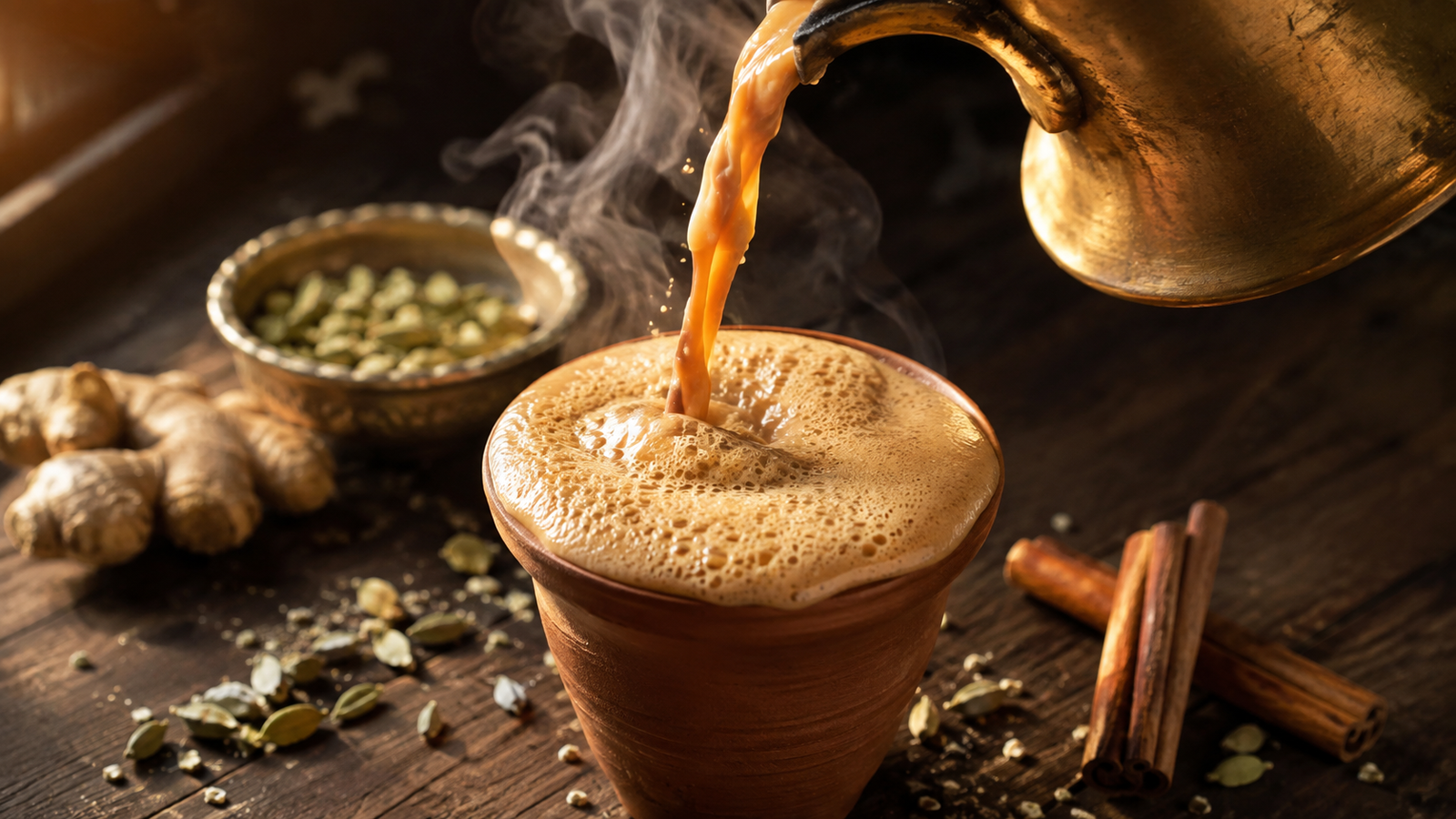
Have you ever wondered why street vendors pour tea from one container to another from a height of three feet? They aren’t just showing off.
- The Physics: This “long pour” introduces Oxygen into the hot liquid.
- The Result: Aerating the tea softens the bitter edge of the tannins, emulsifies the milk fats with the water, and creates a beautiful, frothy foam at the top. Before you serve your tea at home, pour it once or twice from your pot to your mug from a height. You will see an immediate difference in smoothness.
The Step-by-Step Masterclass (The 10-Minute Ritual)
Now, let’s bring the science together into a foolproof kitchen protocol.
The Ingredients (For 2 Perfect Cups)
- Water: 1.5 Cups (Filtered, fresh).
- Whole Milk: 3/4 Cup (Cold).
- Tea Leaves (CTC): 2 Heaped Teaspoons. (Use standard CTC tea like Tata Tea Gold or Red Label for strength).
- Fresh Ginger: 1/2 Inch (Crushed, not grated—grating releases too much bitter juice).
- Green Cardamom (Elaichi): 2 Pods (Crushed open so the seeds are exposed).
- Sugar: 2 Teaspoons (Adjust to taste).
The Brewing Protocol:
Step 1: The Infusion (3 Minutes)
Bring your 1.5 cups of water to a rolling boil in a saucepan. Add the crushed ginger and crushed cardamom. Let them boil on medium heat for 2 minutes.
- Why: This extracts the spicy gingerols and sweet elaichi oils into the water and deactivates the curdling enzymes.
Step 2: The Leaf Drop (2 Minutes)
Add your tea leaves and sugar. Turn the heat to low-medium. Let it simmer for exactly 2 minutes. The water should turn a deep, dark reddish-brown.
Step 3: The Dairy Pour (2 Minutes)
Pour in the cold whole milk. Turn the heat to high. Watch the pot closely. The moment the liquid rises to the top of the pan (the boil), lower the heat instantly to a simmer. Let it rise and fall twice.
- Why: This “rising” action forces the milk fats to bind with the extracted tea oils without burning the milk.
Step 4: The Aeration
Turn off the gas. Use a strainer to pour the tea into your cups, doing at least one “long pour” from a height of one foot to create that signature froth.
Frequently Asked Questions (FAQs)
Q: CTC vs. Orthodox tea: Which is better for a Masala Chai Recipe?
A: For authentic Indian chai, CTC (Crush, Tear, Curl) tea is the winner. It produces a strong, robust color and a deep flavor that can stand up to the fat of the milk. Orthodox (leaf) tea is too delicate and is best enjoyed black or with a lemon wedge.
Q: Can I use jaggery (Gur) instead of sugar?
A: Yes, but never boil jaggery with milk. The sulfur and acids in jaggery will instantly curdle the milk.
- The Hack: Brew your tea with milk and water, turn off the gas, add the grated jaggery to your cup, and strain the hot tea over it. Stir to dissolve.
Q: Why does over-boiled tea give me acidity?
A: Over-boiling extracts heavy tannins. These tannins irritate your stomach lining and trigger your body to produce more gastric acid to digest them. (Refer to our guide on how to cure acidity naturally to understand how stomach pH works!).
The Quiet Mastery of the Morning
Chai is a simple luxury, but it deserves respect.
By making these small adjustments—boiling your ginger first, limiting your leaf-boil time, and using whole milk—you transform a basic morning chore into a ritual of pure, velvety comfort. You aren’t just drinking tea anymore; you are enjoying a perfectly engineered emulsion.
So, tomorrow morning, don’t rush the pot. Turn down the heat, trust the chemistry, and pour yourself a perfect cup from a height.
Your day has officially started.